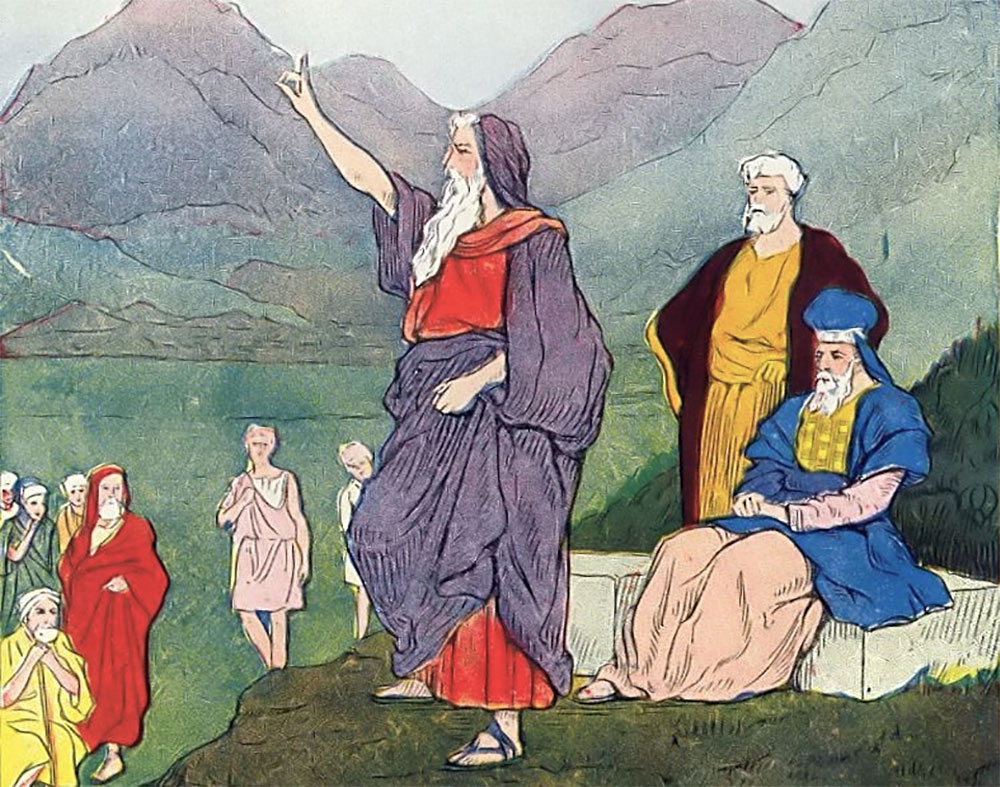
This week I share a teaching from The Sefat Emet, Rabbi Yehudah Aryeh Leib Alter (1847–1905), one of the most influential Hasidic masters of the late 19th century. He comments on the very first verse of the Book of Deuteronomy, our parsha hashavuah, our Torah portion for this week:
“These are the words that Moshe spoke……. (Deuteronomy 1:1)
“When Moses encountered God at the burning bush, Moses declared, “Please, my Lord, I am not a man of words, for I am slow of mouth and slow of tongue.” (Exodus 4:10) Here, however, we begin the book of Deuteronomy with the verse “These are the words which Moses spoke.” In the Book of Deuteronomy Moses is eloquent – he recounts the history of the wanderings in the wilderness, he rebukes the people, he inspires them, he warns them, he even recites poetry – practically the entire Book is composed of Moses’ speeches. How did a man who stuttered, who had no confidence in his verbal abilities at the beginning of his mission, become an accomplished orator? The answer is that before the exodus from Egypt and the receiving of the Torah at Mount Sinai Moses lacked the power to speak the words of God convincingly to Pharoah so that the words could move Pharoah. His own sense of inadequacy inhibited him. But now, after the receiving of the Torah, it is written, “Moses began to expound on the Torah” (Deuteronomy 1:5) – the words became clear and polished and easy to understand. His words are now able to penetrate the deepest recesses of the heart.”
Over the forty years that Moses leads the Israelites, he changes. He begins as a reluctant leader, unsure of his powers of persuasion or his ability to accomplish the sacred mission assigned to him by God. Through many trials, failures and growth, Moses gains confidence in his abilities. By the end of his life, he has truly found his voice – a voice shaped not by natural talent, but by humility, by Torah and by a sense of purpose.
Illustration: Moses speaks to Israel. From “The Boys of the Bible” by Hartwell James, 1905 and 1916.


Leave a Reply