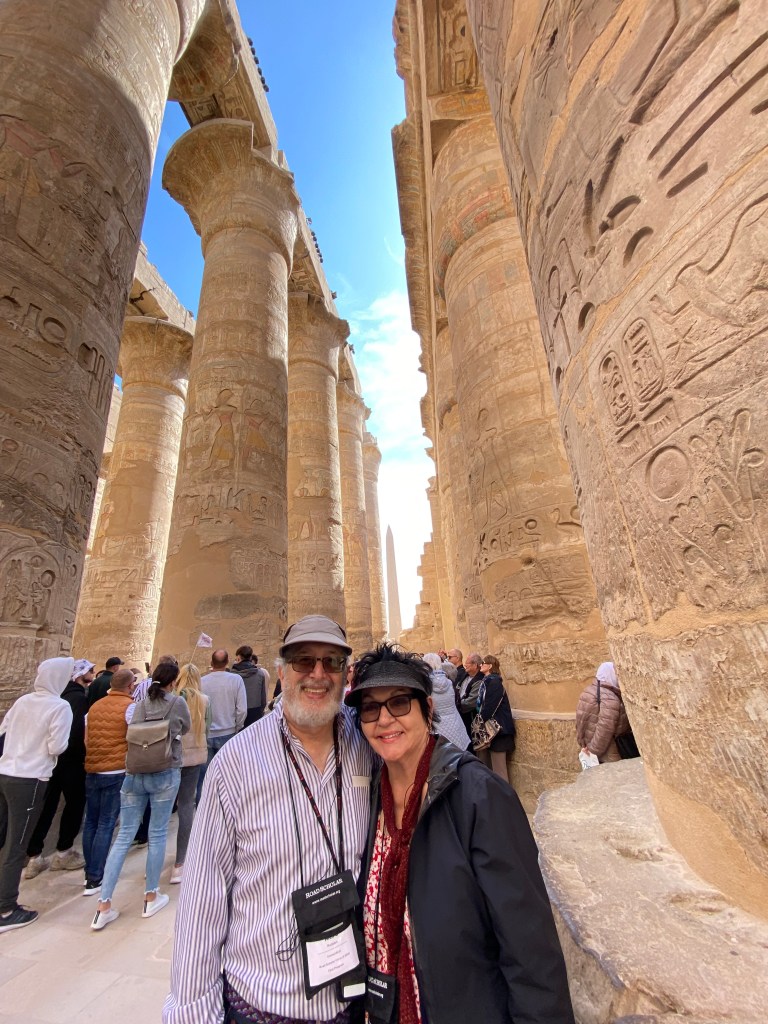
Perhaps the most impressive site that we visited in Egypt was the Temple of Karnak. It is a massive archeological site that dwarfs anything I have seen in Israel. This complex was begun around 2000 BCE. Approximately 30 Pharaohs contributed to its building down to the Ptolemaic dynasty. (300 BCE).
The picture above shows my wife and me standing in The Great Hypostyle Hall. I found myself overwhelmed and in awe. There are 134 massive carved columns arranged in 16 rows. 120 of these columns are 33 feet tall and twelve of the are 70 feet tall! Each column in 10 feet in diameter. Atop these columns sit enormous stone beams, or lintels, each weighing 70 tons! How in the world did the ancient Egyptians raise those massive stones to such heights? In the background you can see the obelisk erected by the Pharoah Hatshepsut. At 97 feet tall, it was the tallest obelisk ever erected at the time. Today it is the second tallest ancient obelisk still standing, surpassed only by the Lateran Obelisk in Rome, a relic from the Pharoah Thutmose III that reaches 105 feet.
Of course, we were looking at the ruins. What must have it looked like when it was a functioning Temple and Palace? I could imagine Moses entering the complex to demand that Pharaoh let the Israelites go. Pharoah, landlord and resident of this majestic building, representing the power and might of Egypt. Pharoah, who considered himself of divine status, godlike, perfect. No wonder when Moses approached him, be bellowed, “Who is the LORD, that I should obey him and let Israel go? I do not know the LORD and I will not let Israel go.” (Exodus 5:2)
The Karnak Temple lay in ruins, a tourist attraction. The mighty civilization of the Pharaohs, that they thought would last forever, has disappeared. Yet tiny Israel, the slave people that Pharoah so disdained, lives on, reborn in its ancient land. Standing in the magnificent ruins of the Karnak Temple, I could not but help recall the words of Mark Twain:
The Egyptian, the Babylonian, and the Persian rose, filled the planet with sound and splendor, then . . . passed away. The Greek and the Roman followed. The Jew saw them all, beat them all, and is now what he always was, exhibiting no decadence, no infirmities of age, no weakening of his parts. … All things are mortal but the Jew; all other forces pass, but he remains. What is the secret of his immortality?
Am Yisrael Chai!

 Rabbi Marc D. Rudolph
Leave a reply to Susan Roberts Cancel reply