When I was a child growing up in Scranton Pennsylvania, the Everhardt Museum of Natural History was a short walk from my house. I would visit frequently on my own. The Bird Gallery had an impressive permanent exhibit of over 600 preserved birds from around the world. The Rocks and Minerals collection featured a case where florescent rocks and minerals lit up. But my favorite exhibits were of the more lurid nature: the shrunken head and the mummy.
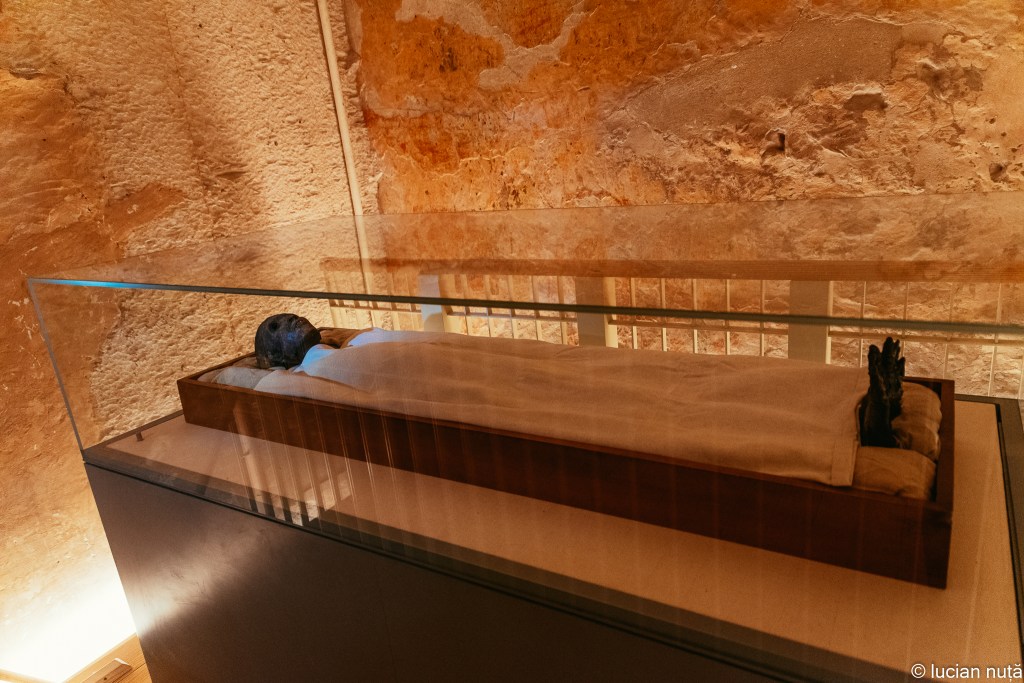
I couldn’t help thinking of that mummy when we visited King Tut’s tomb in the Valley of the Kings in Egypt. The entire contents of his Tomb are on display at the Egyptian Museum in Cairo, which we also visited. But here, in his original place of internment in Luxor, lay the actual remains of the 19-year-old Pharoah.
I wonder how he would feel being on display like this. The tomb was hidden away so that it would never be disturbed. The mummification of the body was a religious ritual meant to preserve the body so that it could travel to the afterlife. If King Tut is in the afterlife, how does he feel being a tourist attraction? In 1980, then Egyptian President Anwar Sadat ordered the mummies locked away because he felt gawking tourists violated the dignity of the dead. (They were returned for display seven years later.) Or would King Tut be happy to at least be remembered? That too is some kind of eternal life.
The Torah tells us that when Jacob died, his son Joseph “ordered the physicians in his service to embalm his father, and the physicians embalmed Jacob.” (Genesis 50:2) This is contrary to Jewish law as we know it, where the body must be allowed to return to the earth, “For dust you are, and to dust you must return.” (Genesis 3:19). When Joseph died, he too was mummified and placed in a coffin. What do we make of our patriarchs following the burial practices of the Egyptians? Had they accepted Egyptian beliefs about the afterlife?
In his commentary on the Book of Genesis, Nachum Sarna suggests that Jacob and Joseph were embalmed for practical reasons only. He notes that Joseph ordered “the physicians in his service” to embalm his father. This was in order to prepare him for the journey to the Land of Caanan for burial in the Cave of Machpelah. Joseph’s physicians could therefore prepare the body physically without the accompanying Egyptian religious rites. Before Joseph dies, he makes the Israelites promise that when “God has taken notice of you” and “brings you up to the land that He promised” ….. “you shall carry up my bones from here.” (Genesis 50:24-26) Joseph is placed in a coffin — an “aron” — used by Egyptians but never again mentioned in the Bible with respect to burial. Joseph’s body in preserved, and indeed, many years later at the time of the Exodus the Israelites take his body with them for burial in the Promised Land.
Photograph By Nuță Lucian from Cluj-Napoca, Romania – Egipt 2020, CC BY 2.0, https://commons.wikimedia.org/w/index.php?curid=116778048


 Rabbi Marc D. Rudolph
Leave a reply to Rabbi Michael G. Kohn Cancel reply