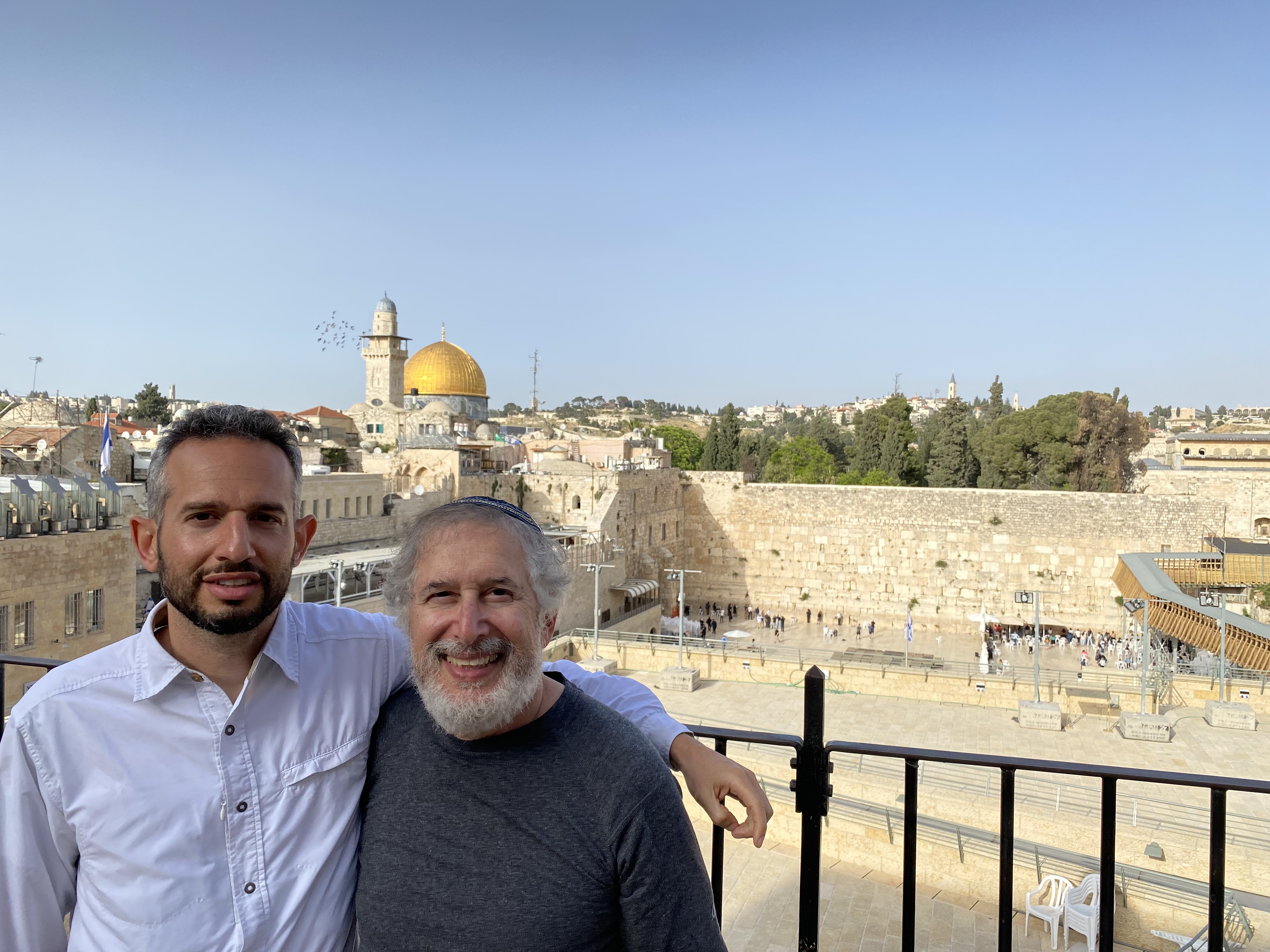
Toward the conclusion of our Seders we recite the words, “Bashannah Habahah Birushalayim Habenuya” — “Next year in Jerusalem rebuilt”. Thus, we begin our seder (“Now we are here, next year may we be in the Land of Israel) and end it remembering our ancestral homeland. This year I thought about my ancestors, having their seders in their villages of Glubokye or Bobruisk in Belarus. The only hope they had of being in Jerusalem “next year” was if the Messiah were to come and begin the Final Redemption. Which is the whole point of the recitation of this verse toward the end of the seder. We declare that “the order of the Passover ritual has been completed according to law, in accordance with all of its rules and regulations.” Then we ask God to find us worthy of experiencing the Final Redemption, the ingathering of the exiles to a rebuilt Jerusalem in our own time.
Of course, today we can hop on a plane and be in Jerusalem in less than 24 hours. That is exactly what my friend and former congregant Yvonne Baevsky did this year. She was visiting her family in Jerusalem for Passover and wrote me that “Jerusalem is bustling! Restaurants are busy and hotels are packed.”
That was great news to hear on the 553rd day of war.
I first learned about Jerusalem in Hebrew School in the early 1960s. It was then that I became an ardent Zionist. I remember coming home one day and telling my father about what we were learning about Israel. “Wouldn’t you love to go to Jerusalem some day?” I asked. I was disappointed in my father’s response. He had been to Jerusalem as a soldier during the Second World War. Jerusalem, he said, was hot, dusty, smelly and filthy. He had no desire to return.
Theodore Herzl, the founder of modern Zionism, had a similar response upon visiting Jerusalem for the first and only time. It was 1898, only 50 or so years before my father’s “visit”. Herzl was repulsed by the filth and disrepair that he saw in Jerusalem. “We have been to the Wailing Wall,” he wrote in his diary. “A deeper emotion refuses to come because the place is pervaded by a hideous, wretched, speculative beggary….” He further wrote, “When I remember thee O Jerusalem, in days to come it will not be with pleasure.” Yet Herzl could also see that Jerusalem had the potential to be a beautiful city. He believed that if the Jewish people could make it part of their homeland, it could rise to its former glory once again. “Tender care can turn Jerusalem into a jewel. Include everything sacred inside of the old walls, spread everything new around it.”
Those who visit Jerusalem today can see that Herzl’s vision for the city has been largely realized. Jerusalem is indeed a beautiful city, a united city, a city rebuilt. The new Jerusalem stretches out over the hills and into the valleys that surround the Old City. My great grandparents could only dream of visiting Jerusalem, a dream that has been realized in our own time.

 Rabbi Marc D. Rudolph
Leave a comment